
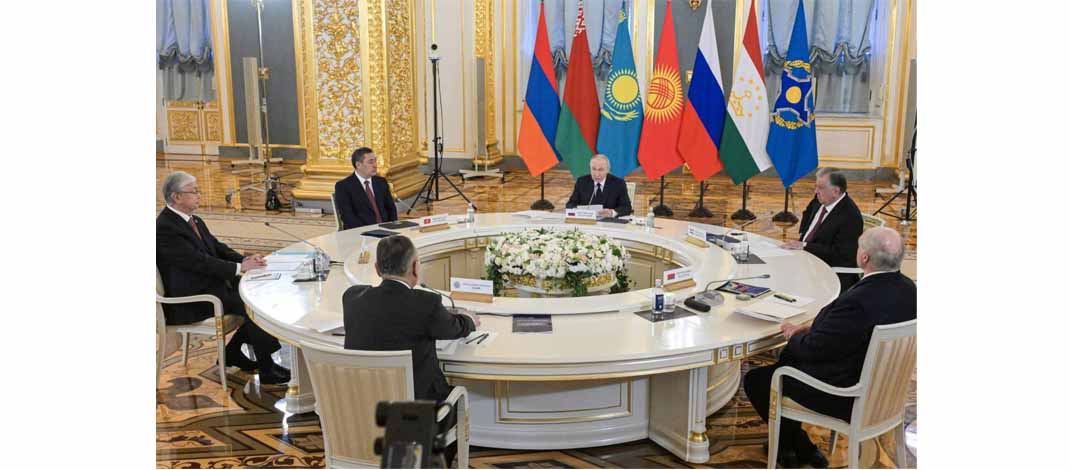
Moscow : Russian President Vladimir Putin chaired a meeting of the Collective Security Council of the Collective Security Treaty Organization (CSTO). He said the participants reached full mutual understanding on every issue discussed, and that they reaffirmed their commitment to join efforts against threats to collective security. The information with photograph of the meeting is released by the Ministry of Foreign Affairs of Russia on its official account of ‘X’.
Reports from the meeting say it was held at the Grand Kremlin Palace. It ended with the adoption of a joint statement by the Council. Kazakhstan’s President Kassym-Jomart Tokayev thanked Putin for hosting and described Russia’s chairmanship of the bloc this year as productive. He also raised security risks linked to artificial intelligence.
About the CSTO
- What it is: The CSTO is a Russia-led military and security alliance of post-Soviet states. Its roots lie in the 1992 Collective Security Treaty, which the remaining members turned into a full organisation in 2002.
- Highest body: The Collective Security Council, made up of the heads of member states, is its highest decision-making body. It meets to set strategic priorities and approve key policy directions.
- Mutual defence clause: Article 4 of the treaty says aggression against one member is to be treated as aggression against all, and it is often compared to NATO’s Article 5. Members are expected to help an attacked state, including with military support. Analysts note the clause has never been formally activated.
- Active members: The bloc is generally described as having five active members: Russia, Belarus, Kazakhstan, Kyrgyzstan and Tajikistan.
- Armenia: Armenia froze its participation in 2024 and stopped paying dues and joining exercises. Its leadership accuses the bloc of failing to act on its treaty obligations during the clashes with Azerbaijan, and says leaving is now more likely than returning. The CSTO says Armenia has suspended its participation rather than withdrawn. A Russian envoy said the bloc might discuss suspending Armenia’s participation rights at this summit, and that any such decision would need consensus. I could not confirm whether that was decided.
- Past exits: Georgia and Azerbaijan left in 1999, and Uzbekistan suspended its membership in 2012.
Putin and Russia’s role
- Chair for 2026: Russia took over the CSTO chairmanship on 1 January 2026, under the motto “Collective Security in a Multipolar World. One Goal, Shared Responsibility.”
- Priorities: Putin has said Russia would focus on collective security, counterterrorism and military cooperation. This includes preparing a new CSTO anti-terrorism strategy and strengthening the bloc’s military potential.
- Arms proposal: At the previous summit in Bishkek in November 2025, he proposed a large programme to equip the CSTO’s Collective Forces with modern Russian weapons and equipment.
- Hosting: Russia hosted the Council of Foreign Ministers in Kazan in June 2026 and the leaders’ session in Moscow in November. An International Forum on Ensuring Collective Security was held alongside the Moscow summit.
- Russia’s weight in the bloc: Russia is by far the largest and most powerful member, and the alliance is widely seen as an instrument of Russian influence in the region.
Differing views
Russia and its allies present the CSTO as a framework for coordinated security against terrorism, extremism and instability. Critics, including Armenia’s leadership and many outside analysts, argue that it has been ineffective in practice. They point to its inaction in the Armenia-Azerbaijan conflict, in clashes between Kyrgyzstan and Tajikistan, and in other disputes, and see the bloc as dominated by Moscow’s interests.